
Gas furnaces
Forced-air gas furnaces of several generations, from standing-pilot units to modern condensing models with control boards and pressure switches.
24/7 RESIDENTIAL HEATER REPAIR IN TACOMA|Call Now For Service Availability: 253-215-2765
24/7 HEATER REPAIR • CALL 253-215-2765
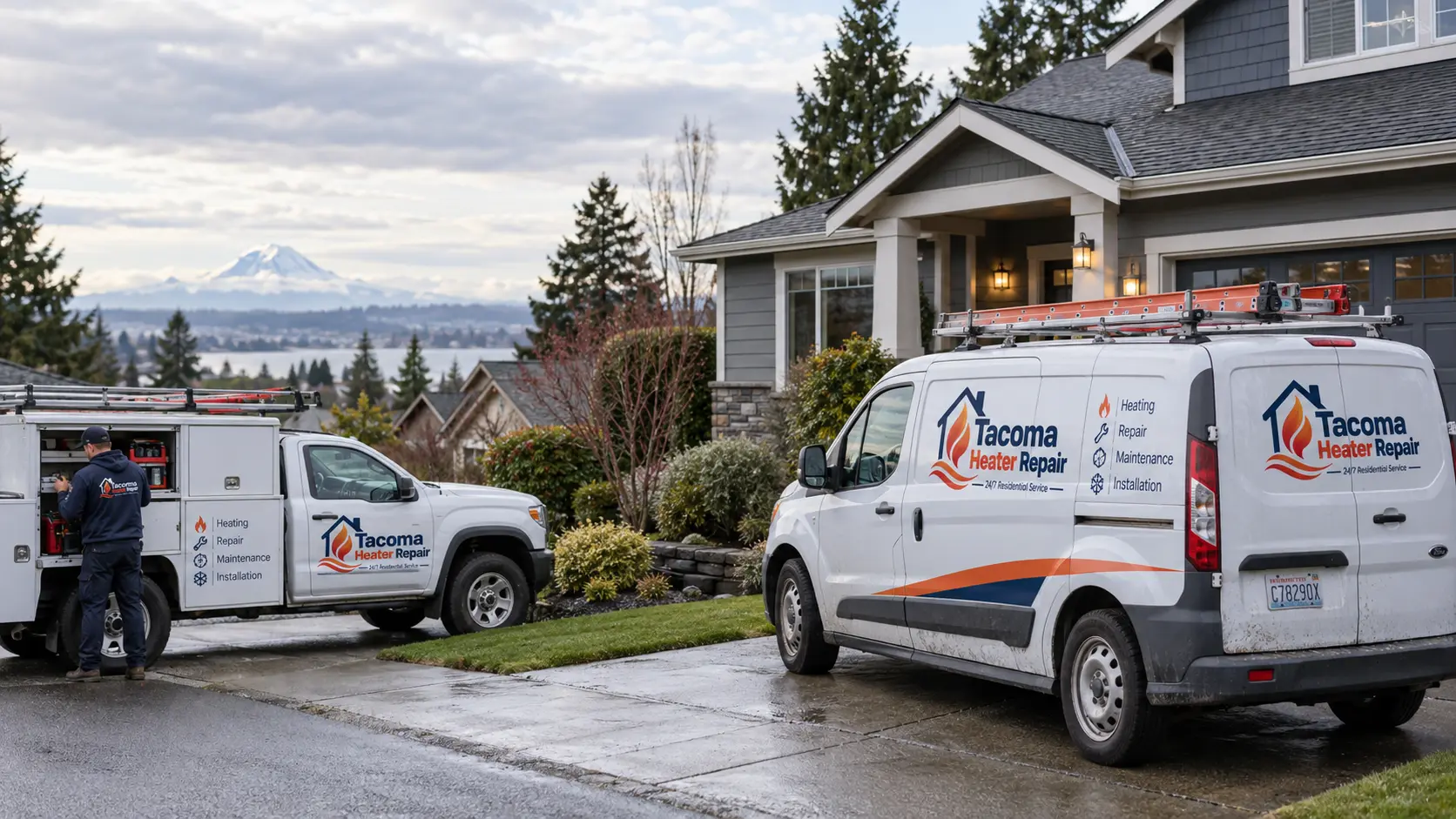
Residential Heating Repair • Tacoma, WA
Heater Repair Tacoma WA — 24/7 Residential Service
We repair home heating systems for Tacoma homeowners and nearby Pierce County communities — gas and electric furnaces, forced-air heating, heat pumps, thermostats, blowers and ignition components. Every call starts with troubleshooting and diagnosis, not a guess. Heater repair calls are answered 24 hours a day, and quotes are free. This is residential service for homes only.
Call now FOR FREE QUOTE and for service availability. Please have your 5-digit ZIP code ready.
When the heat goes out in a Tacoma home, the house cools quickly — especially in a damp Pacific Northwest winter, where indoor comfort depends as much on managing moisture as on raw temperature. Most calls we take start the same way: the thermostat is asking for heat and the house is not getting it. What follows is a short list of the symptoms homeowners describe most often, and what each one usually means for the system.
The system is silent, or the blower runs briefly and stops. This is the most urgent category and also the broadest — it can be a thermostat that lost power, a tripped breaker, a safety switch that opened, a failed ignitor or a control board that no longer sends the signal. Diagnosis works backward from the thermostat's call for heat to whatever is interrupting it.
Air is moving, but it isn't warm. On a gas furnace the burner may be failing to stay lit; on an electric system a heating element or sequencer may be out; on a heat pump the unit may be in defrost or short on refrigerant charge. The fix depends entirely on which of those it is, which is why measuring temperature rise matters.
Faint registers, rooms that never catch up, and a house that feels warm near the furnace and cold at the far end. Filters, blower condition, duct leakage and closed registers all play a part. Older Tacoma homes that have been remodeled frequently have duct runs that no longer match the floor plan they serve.
A heater that starts and stops every few minutes is usually overheating and protecting itself, or getting a confused signal from its thermostat. Either way it burns through component life fast. The same is true of a system that runs for a while and then shuts down entirely until it is reset.
A blank screen, a display that won't hold a setting, or a thermostat that reads several degrees off from the room. Sometimes it's batteries. Sometimes it's a low-voltage fuse or a wiring fault upstream, and the thermostat is only the messenger.
Squeals, scrapes, rattles and booms each point in a different direction, and the timing matters — a boom at ignition is a different problem from a squeal that lasts the whole cycle. A short dusty smell at the first cold snap is normal. A persistent burning or electrical odor is not; shut the system off and call.
Systems that take several attempts to light, or that lock out and retry, generally have an ignitor, flame sensor, gas valve or venting issue. And if your heating use has climbed without a change in habits, the system is likely working harder than it should to reach the same temperature — restricted airflow and degraded components are usual suspects.
Home space-heating equipment: the heat source, the blower, the controls and the ducts that deliver warm air to your rooms.
Forced-air gas furnaces of several generations, from standing-pilot units to modern condensing models with control boards and pressure switches.
Electric forced-air systems where heat comes from resistance elements staged by sequencers and protected by limit switches.
Whole-home electric heating tied into home wiring, including controls, relays and breakers that keep it running.
Any system that heats air centrally and moves it through ducts — the most common arrangement in Tacoma-area homes.
Heat pumps used for heating in cool, damp winter conditions, including defrost behavior and auxiliary heat operation.
Mechanical, digital and smart thermostats, along with the low-voltage wiring that carries the call for heat.
Blower motors, wheels and capacitors that move heated air — the component most airflow complaints trace back to.
Hot-surface ignitors, standing pilots, thermocouples and the ignition sequence that has to complete for the burner to stay lit.
Sensors that confirm flame is present; when they foul, the furnace shuts the gas valve as designed.
High-limit, rollout and pressure safety switches that stop operation when temperatures or venting fall outside safe ranges.
Supply and return ductwork, registers and filter housings that determine whether heat actually reaches your rooms.
Service availability can vary by system. Call with your ZIP code and system type.
What homeowners describe, and what usually causes it. These explanations are here to help you understand your system — not to replace a hands-on diagnosis.
Nothing happens when the thermostat calls for heat. Batteries, a tripped breaker, a blown low-voltage fuse, an open blower-door switch or a failed control board are all common causes. Because several of these live inside energized equipment, the safe homeowner checks are the thermostat, the breaker and the filter.
The blower runs but the air never warms. On gas systems this often means the burner is not staying lit; on electric systems an element or sequencer may have failed; on heat pumps it may be a defrost cycle or low refrigerant charge. We measure temperature rise to tell these apart.
Short cycling is usually a symptom of heat building up faster than air can carry it away. Restricted filters, closed registers, crushed ducting or a failing limit switch are typical. Left alone, repeated overheating shortens the life of the heat exchanger and blower motor.
A blank or frozen thermostat may have dead batteries or may have lost 24-volt power from the equipment. Miswired replacement thermostats are also common after a DIY upgrade. We verify the control signal at both ends before replacing hardware.
Rooms warm slowly and vents feel faint. Clogged filters, a dirty blower wheel, a failing capacitor, closed or blocked registers and leaky duct connections all reduce delivered air. Weak airflow also makes the rest of the system run hotter than it should.
Scraping can indicate a blower wheel contacting its housing, squealing often points to a motor or bearing, booming on start-up can mean delayed ignition, and rattling may simply be loose panels or ducting. Booming and burning smells should be treated as urgent.
Older systems use a standing pilot that can be extinguished by drafts or a failing thermocouple. Newer furnaces use a hot-surface ignitor and a flame sensor that grows a film of residue over time. Repeated lockouts after three or four ignition attempts are a classic sign.
If air keeps moving long after the call for heat ends, the thermostat fan setting may be on, a fan relay may be stuck, or the limit switch may be holding the blower on because the cabinet is still hot. Continuous cool air can make a working home feel colder than it is.
Uneven temperatures are common in Tacoma homes that have been remodeled or added onto. Duct runs may be undersized, disconnected in a crawlspace, or balanced for a layout that no longer exists. We check static pressure and register output rather than guessing.
A heating circuit that trips repeatedly is telling you something is drawing too much current — a shorted heating element, a seizing blower motor or damaged wiring. Reset once at most. Repeated resets on a faulting circuit are a fire risk, so this one needs a technician.
Dust burning off at the first cold snap fades within an hour. A sharp, acrid, plastic-like smell that persists suggests overheating wiring, a failing motor or a scorched control board. Shut the system off at the thermostat and call for service rather than continuing to run it.
Some systems lock out, pause, then try again — a pattern that points to a safety control doing its job. Pressure switches, rollout switches, condensate safeties and high limits all interrupt operation for real reasons. Reading the control board's fault code shortens diagnosis considerably.
Eight causes account for most no-heat calls in residential systems.
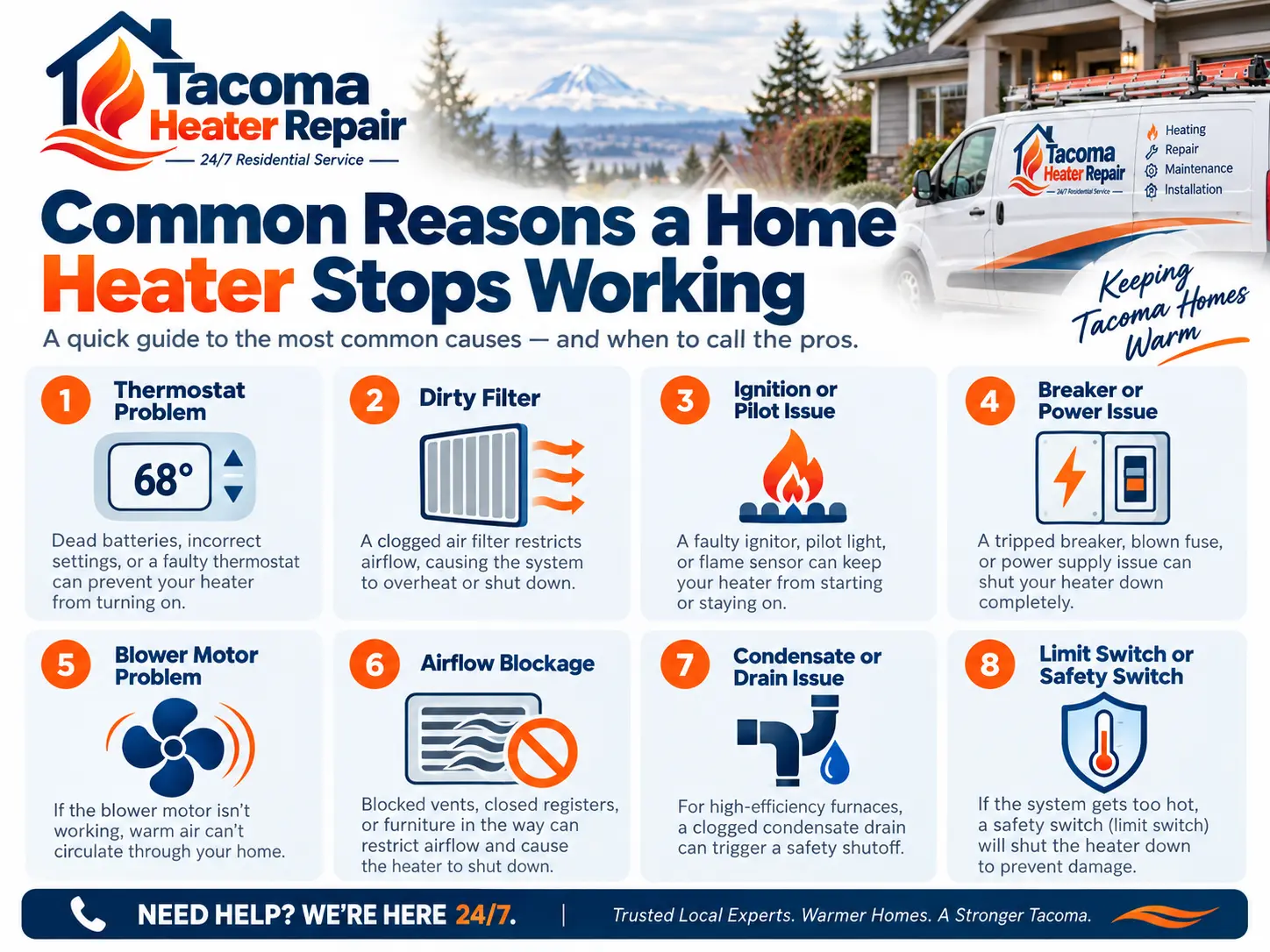
Two of the eight — thermostat settings and a dirty filter — are things a homeowner can reasonably check without tools. Confirm the thermostat is set to heat and a few degrees above the current room temperature, and pull the filter to see whether light passes through it. Those two checks resolve a meaningful number of calls before anyone needs to come out.
The other six involve the burner compartment, electrical controls or the venting and drain system, and they are where a technician's tools matter. Ignition faults stop the burner from staying lit. Power problems and tripped breakers cut the system off entirely. A failing blower motor prevents heated air from circulating even when the heat exchanger is hot. Airflow blockage and a clogged condensate drain both trigger safeties. And a limit switch shutting the system down is usually the symptom of an overheating problem rather than the problem itself — which is why replacing the switch without finding the cause tends not to last.
If your system matches one of the last six, call 253-215-2765 rather than opening the cabinet. You can also read our guides on heaters blowing cold air and short cycling.
Understanding the path air takes through your home makes most heating symptoms much easier to interpret.
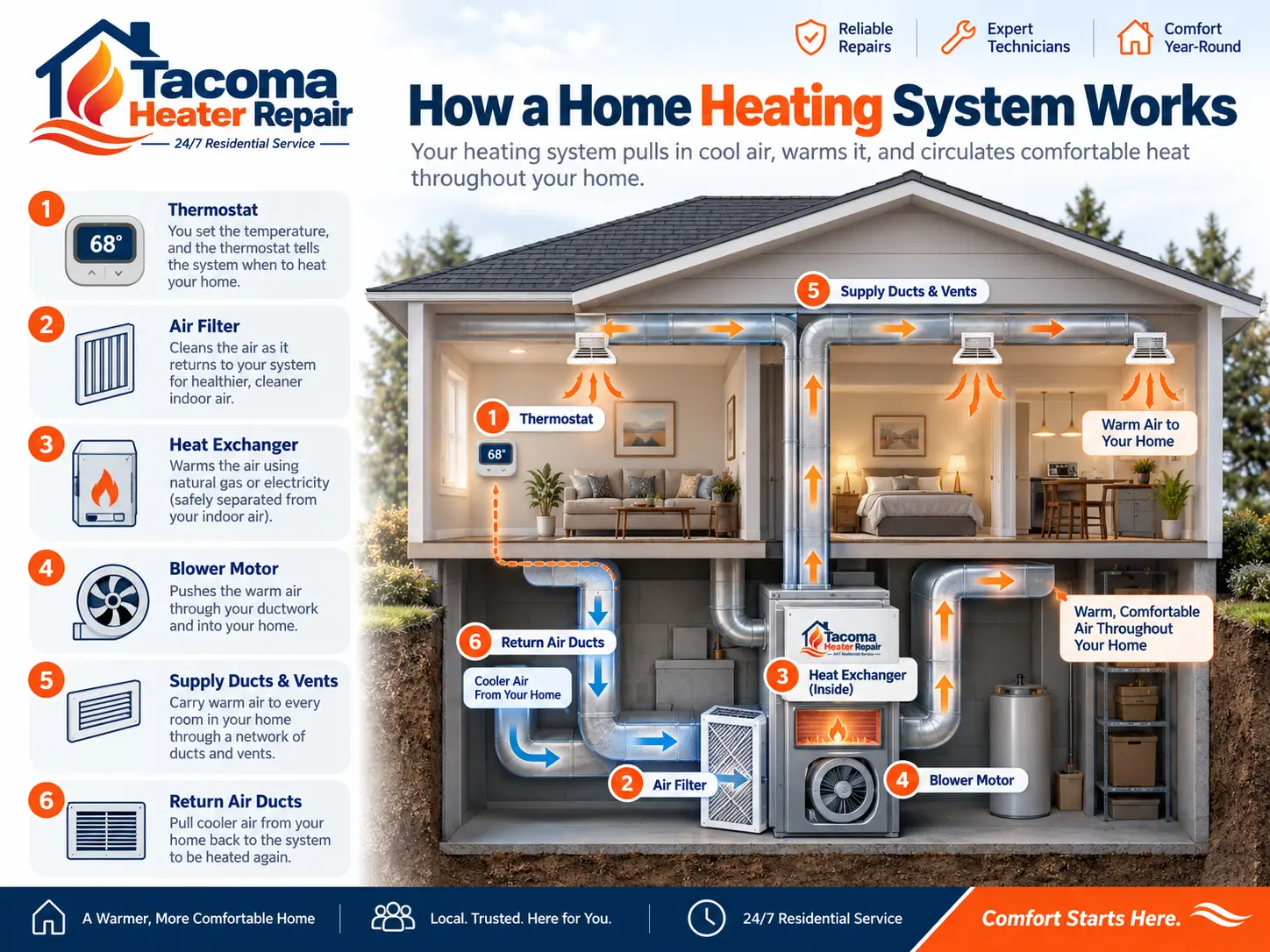
The thermostat is a switch with an opinion. It compares the room temperature to your setting and closes a low-voltage circuit to ask the equipment for heat. If that request never reaches the control board, nothing else in the chain matters.
Cooler air from your living space is pulled back to the equipment through return ducts. A system starved of return air cannot heat properly no matter how well the burner works — which is why blocked returns and undersized returns cause symptoms that look like equipment failure.
Return air passes through the filter, which protects the blower and heat exchanger from dust. It is also the single most common cause of preventable failures, because a loaded filter chokes airflow and drives cabinet temperatures up.
A gas furnace ignites a burner. An electric furnace energizes resistance elements in stages. A heat pump moves heat from outdoor air into your home, with electric backup when conditions demand it. Each has its own start-up sequence and its own failure modes.
In a gas system, combustion happens inside the heat exchanger, and your indoor air passes over the outside of it — never through it. That separation is a safety boundary, which is why a cracked heat exchanger is treated seriously rather than patched.
The blower pushes warmed air into the supply ductwork. Its speed, the condition of its wheel and the health of its capacitor all determine how much heat actually leaves the equipment.
Ducts distribute heated air to each room, and registers deliver it. Leaky duct joints in a crawlspace or attic dump heat where nobody lives, and closed registers push pressure back toward the equipment. Balanced airflow is what makes a house feel evenly warm.
Air returns to the equipment and the loop repeats until the thermostat is satisfied. Nearly every symptom in the section above is a break in that loop — which is why we trace the loop instead of replacing parts hopefully.
Six steps, from your first call to a verified repair.
Your 5-digit ZIP tells us immediately whether your address falls inside our residential service area.
What the system does, what it sounds like and when it started all narrow the likely cause before anyone arrives.
We confirm current availability for your address and system type on the phone, including after-hours calls.
We test the call for heat, the ignition or heating sequence, airflow, safety controls and electrical components.
You hear what failed, what it affects and what the repair involves — in plain language, before work begins.
After you approve the work, we complete the repair and verify the system heats, cycles and shuts down correctly.
24/7 Residential Service for Tacoma-area homeowners.
Call now FOR FREE QUOTE and for service availability. Please have your 5-digit ZIP code ready.
Each page covers one system or situation in detail.
Diagnosis and repair for home heating systems across Tacoma.
Gas and electric furnace troubleshooting, ignition and airflow issues.
Electric furnaces, heating elements, relays, breakers and controls.
No-heat calls answered around the clock, 24 hours a day.
Heat pumps running in cold, damp Pacific Northwest weather.
Unresponsive, miswired or failing thermostats and controls.
Related searches Tacoma homeowners make, answered properly.
Home heater repair covers the equipment that heats your living space: a gas or electric furnace, a heat pump, the ductwork that distributes air, and the thermostat and controls that run the whole sequence. The calls we take most often are no heat, cold air from the vents, short cycling, weak airflow and unfamiliar noises. What makes residential work different from large-building heating is the scale and the priorities — a single system serving one family, in a house that has often been modified over decades, where the goal is to restore comfort quickly without disrupting the home. Many Tacoma houses also mix generations of equipment: a newer condensing furnace attached to original ductwork, or a heat pump added to a home that was designed around resistance heat. That mix is exactly why diagnosis comes first. We check the call for heat, the ignition or heating sequence, airflow and the safety controls, then explain what we found and what the repair involves before anything is replaced. Repair is residential only — houses, condos and townhomes. Call 253-215-2765 with your ZIP code and system type to confirm availability.
Electric heating fails differently than gas, and the symptoms can be misleading. The blower often keeps running and moving air, so the system feels like it is working while the house gets colder. The usual causes fall into a short list. Heating elements burn out — sometimes one of several, which is why heat can feel weak rather than absent. Breakers trip because electric heat draws heavy current, and a breaker that trips repeatedly is reporting a real fault, not a nuisance. Sequencers and relays that stage the elements can stick open or closed. Thermostats fail to send a usable signal, or get miswired during a smart-thermostat upgrade. Blower motors and capacitors weaken, which reduces airflow and pushes cabinet temperatures up. And safety controls — high limits in particular — cut power when the equipment overheats, usually because airflow is restricted upstream. The homeowner checks that are safe here are the thermostat, the breaker (reset once only) and the filter. Everything past that point sits behind energized panels carrying substantial voltage, so please don't open the cabinet. See our electric heater repair page for more.
There is no single price for heater repair, because "heater repair" spans everything from a thermostat replacement to a blower motor. What actually drives your cost: the type of system, since heat pumps involve refrigerant work that gas furnaces don't; which component failed, since an ignitor and a blower assembly sit at opposite ends of the parts range; the diagnostic work needed, because an intermittent fault takes longer to isolate than a clear one; accessibility, since a furnace in a tight crawlspace or a cramped closet takes longer to work on than one in an open garage; parts availability and whether the model is still commonly stocked; whether the call is routine or an after-hours urgent visit; the age and overall condition of the equipment, which affects how surrounding parts hold up during a repair; and whether one component failed or several are involved. Pricing varies by system and diagnosis. For a planning range based on your own system, problem, urgency and equipment age, use our heater repair cost calculator, then call for a free quote.
We're not going to tell you we're the best — that's a claim anyone can type. The more useful question is: what should Tacoma homeowners actually look for when choosing a heater repair company? Start with residential heating experience specifically; a company whose work is mostly large-building systems brings different habits to a house. Ask how they diagnose. You want a clear explanation of what failed and why, not a parts list handed over at the door. Look for transparent repair options, including what happens if the first repair isn't the whole story, and a written estimate where the situation allows for one. Confirm the service area covers your address before you wait — a company that can't reach you tonight isn't an option tonight. Ask whether safety checks are part of the visit: venting, combustion-area condition, electrical connections and safety switches all matter and are easy to skip. Pay attention to communication, both on the phone and on site, because a technician who can explain findings in plain language is usually one who understood them. And notice whether they ask about your ZIP code, system type and symptoms up front — the questions a company asks tell you how they work.
Pricing varies by system and diagnosis. Rather than advertise a number that wouldn't apply to your home, here is an honest look at the categories that determine what a repair involves.
Every repair starts with finding the fault. A system that fails consistently is faster to diagnose than one that works until it doesn't. Access matters too: crawlspaces, attics and tight closets add time that an open garage installation doesn't.
Batteries, a blown low-voltage fuse, a loose connection or a failed thermostat sit at the simpler end. These are often quick repairs once the cause is confirmed — the diagnosis is usually the bulk of the visit.
Hot-surface ignitors, flame sensors, thermocouples and gas valves are common replacements on gas furnaces. Cleaning a flame sensor and replacing an ignitor are very different jobs from replacing a gas valve, so this category spans a wide range.
Capacitors are modest. Blower motors and full blower assemblies are among the more substantial repairs on a forced-air system, partly because of the part and partly because of the labor to remove and reinstall it.
On electric systems, elements and the sequencers that stage them are frequent failure points. Systems with multiple elements may need more than one addressed depending on condition.
Sometimes the repair is the airflow: a badly clogged filter housing, a disconnected duct run, a blocked return. These often cost less than the components they were on their way to destroying.
Limit switches, pressure switches, rollout switches and control boards vary from inexpensive to significant. With safeties, the important work is finding why the switch opened, because a replacement alone rarely ends the problem.
Older equipment can require parts that are harder to source, and surrounding components may be near the end of their own service life. After-hours and urgent no-heat calls are priced differently than routine scheduled service. For a planning range tailored to your situation, use the cost calculator, and read how much heater repair costs in Tacoma.
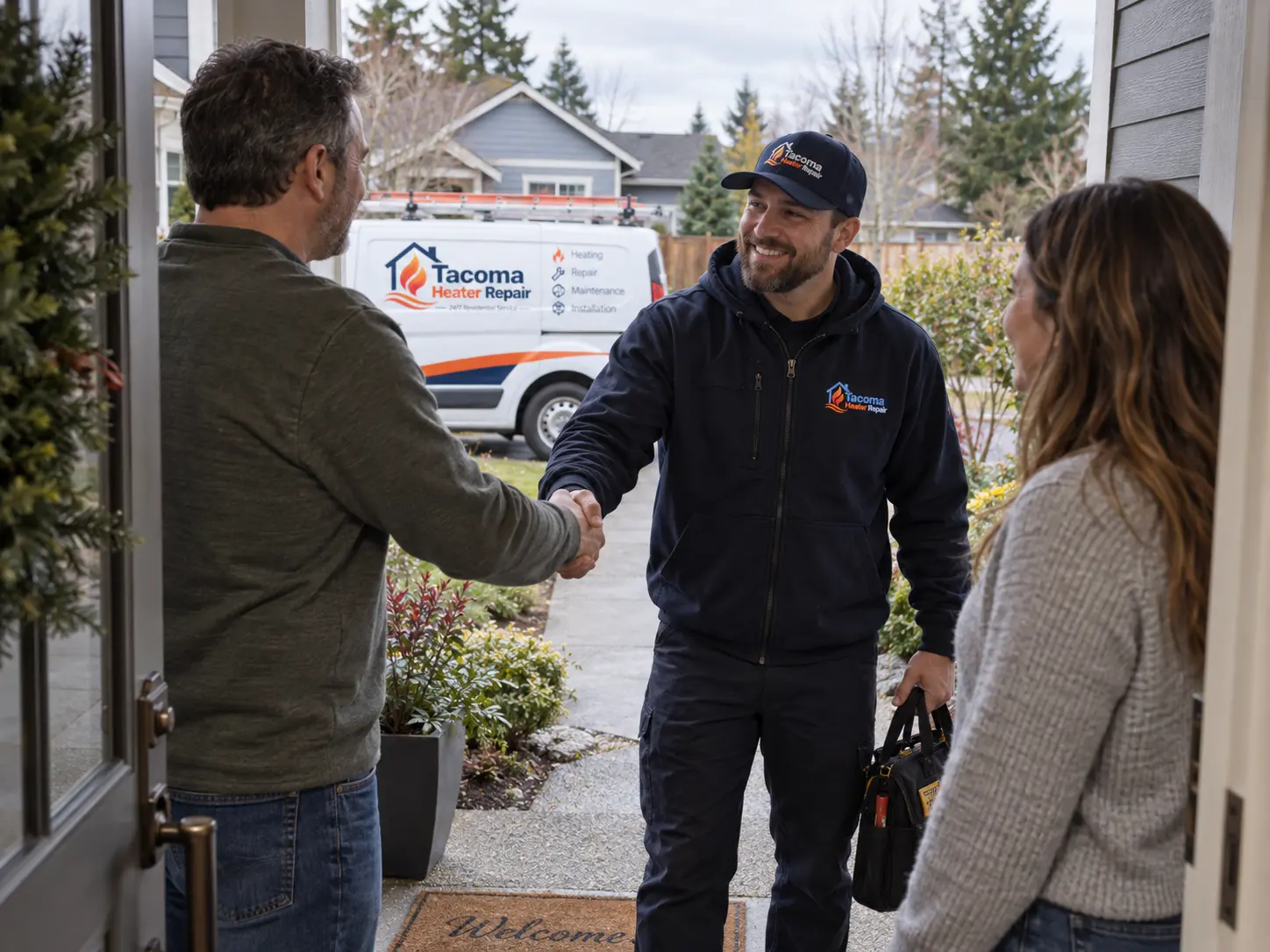
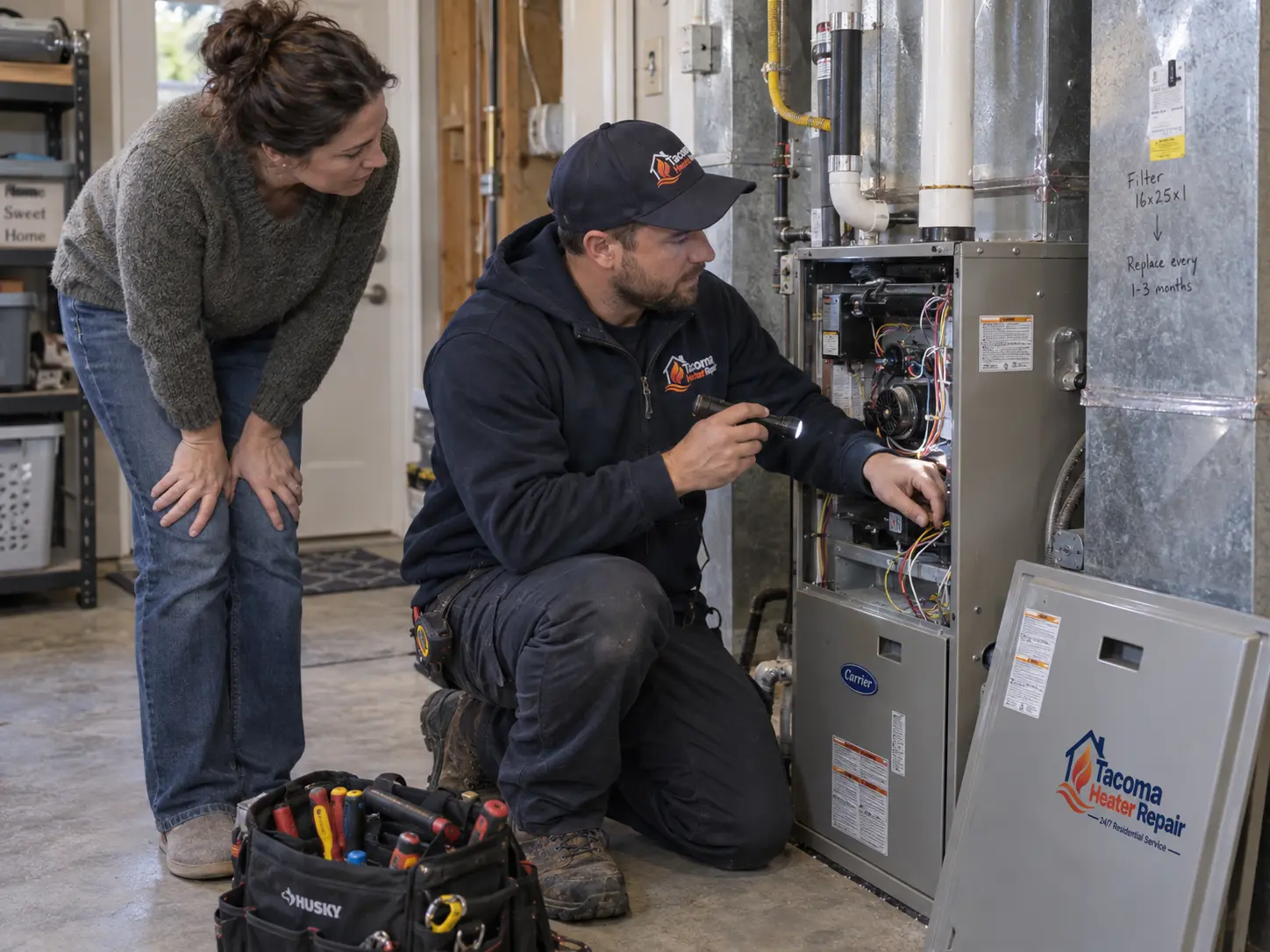
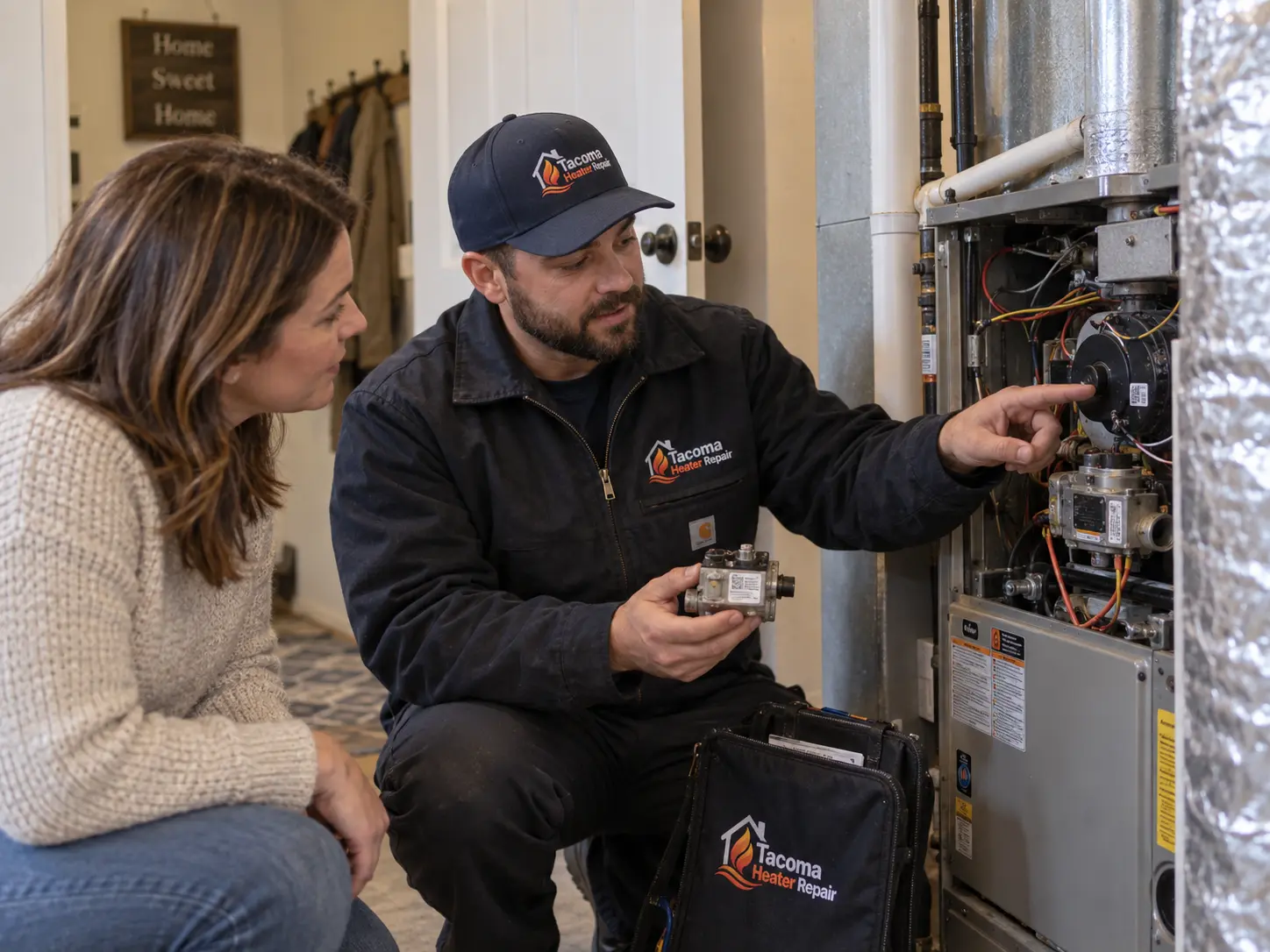
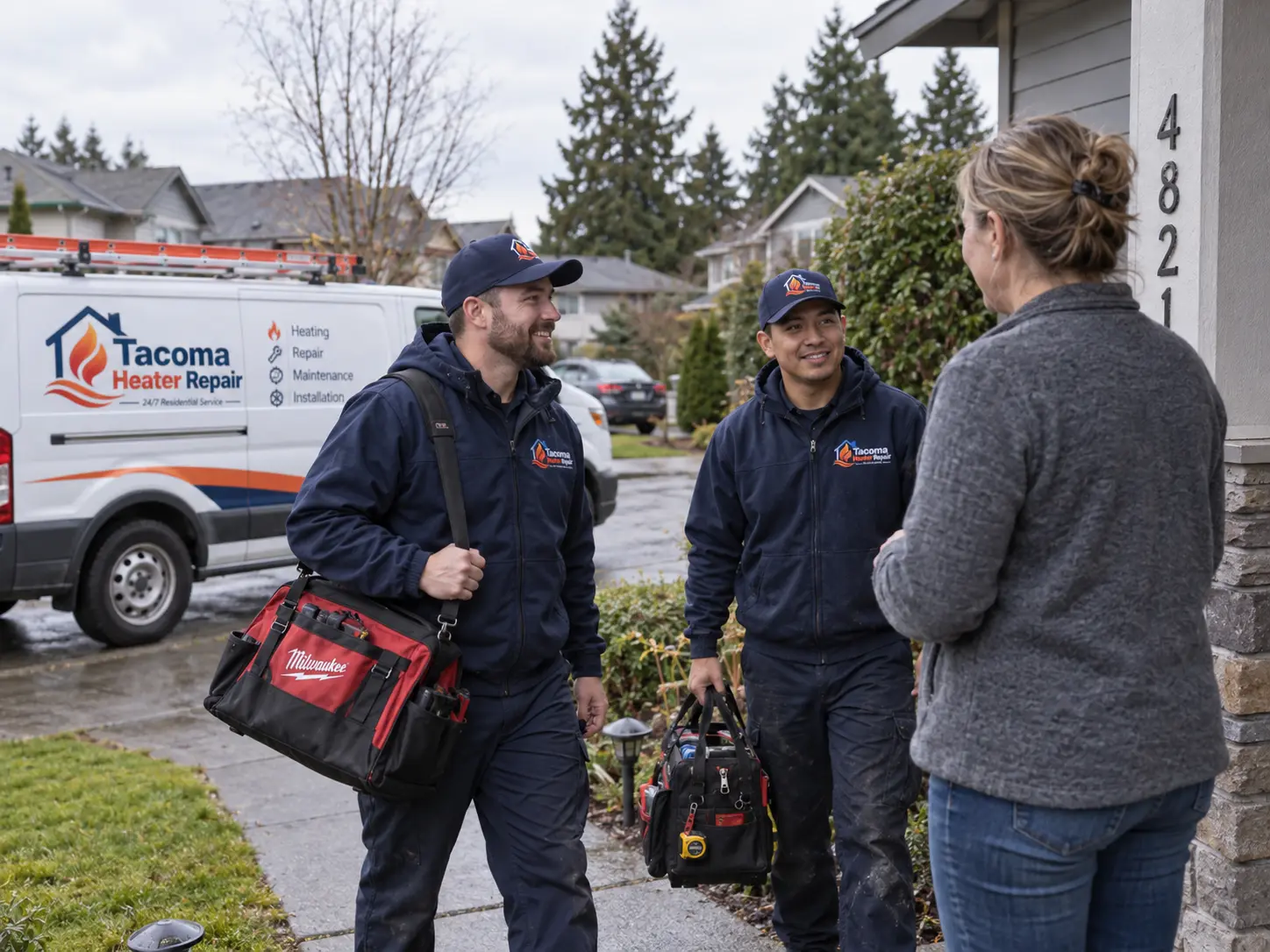
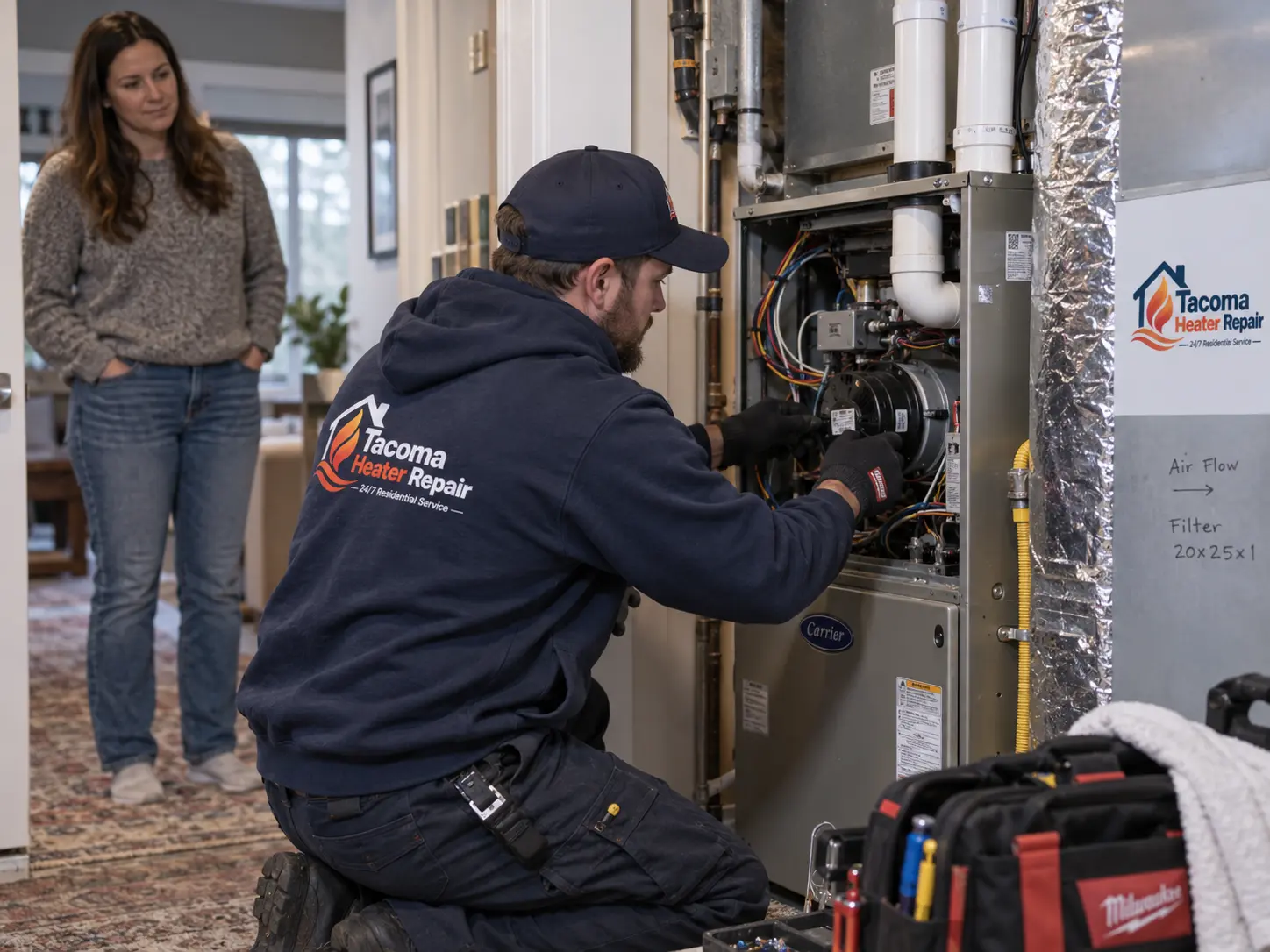
Neighborhoods we serve across the city. These are service areas only — our office is at 950 Broadway Suite 97.
Tacoma's housing stock spans more than a century, and so does its heating equipment. Craftsman homes in the North End and Proctor often have ductwork that predates modern airflow expectations. Mid-century houses in South Tacoma and the Lincoln District frequently carry furnaces that have been swapped once or twice onto original ducting. Newer construction in Northeast Tacoma and around Browns Point leans more often toward heat pumps. Each of those situations behaves differently when something fails.
The Pacific Northwest heating season is long and damp rather than extreme. Systems run for months at moderate load, which means filters load up steadily, blower wheels collect dust, and small airflow restrictions have time to turn into overheating shutdowns. Cool, wet conditions also make even-temperature performance more noticeable — a room that runs a few degrees behind feels clammy rather than just cool. Keeping filters fresh and registers open through the heating season prevents a real share of the failures we see.
Beyond the city, we serve nearby residential communities across Pierce County and south King County. See the full service area list for details by city.
Our Broadway address sits downtown, a short run from the North End, Hilltop, the Stadium District and the Eastside, and within reach of Lakewood, University Place, Fircrest, Fife, Puyallup and Gig Harbor. Whether your home is a few blocks away or across Pierce County, call with your 5-digit ZIP code and we'll confirm availability for your address.
Call now FOR FREE QUOTE and for service availability. Please have your 5-digit ZIP code ready.
Call 253-215-2765 — FREE QUOTE. 24/7 Residential Service.
Call now FOR FREE QUOTE and for service availability. Please have your 5-digit ZIP code ready.